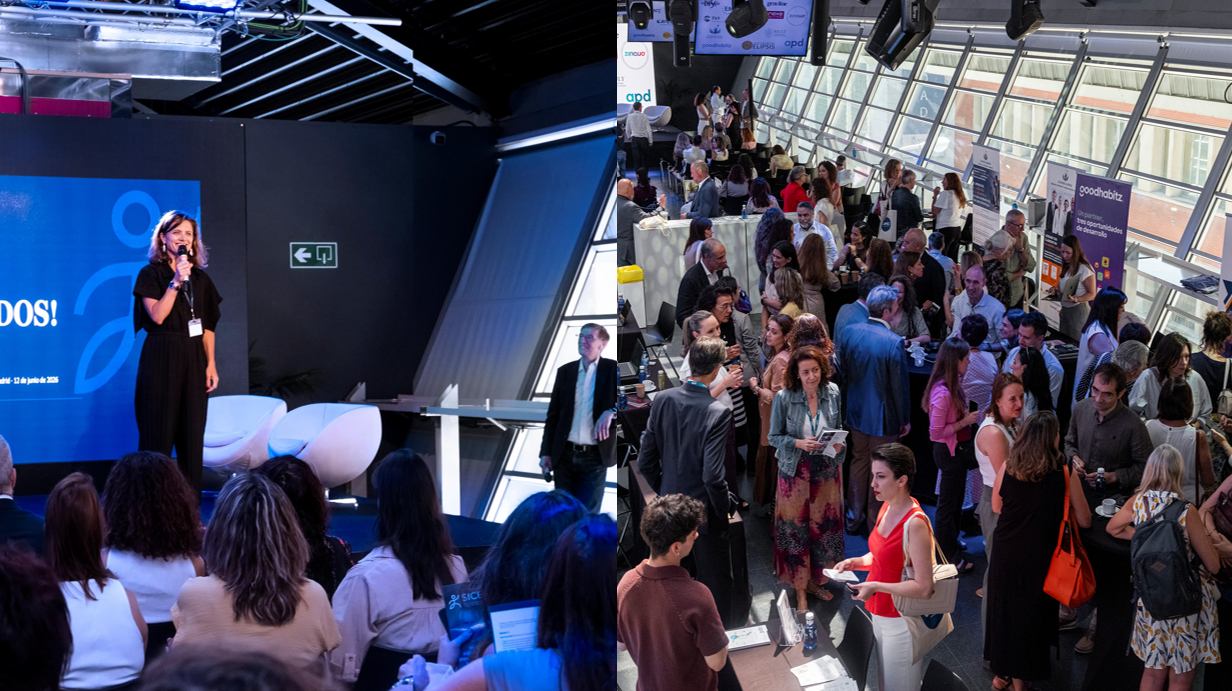
I’m sharing Juan Carlos Cubeiro. PREMIO NACIONAL DE MANAGEMENT summary of the International Executive Coaching Conference we experienced at Movistar Arena in Madrid.
There is little more to add. Just a heartfelt thank you to all the attendees, the speakers, the SICE team and John Leary-Joyce, CEO of AoEC – The Academy of Executive Coaching, for their energy and contribution to making the level and quality of the event truly outstanding.
See you at the next edition of SICE!
On June 12th, I saw the spectacular success of the 1st International Executive Coaching Conference (SICE), held at the Movistar Arena.
Around 1,400 registered professionals, a full house throughout the nine-hour event, and first-class speakers addressing cutting-edge topics. There could be no better way to launch the activities of the AoEC, the Academy of Executive Coaching, in Spain.
Virginia Molet, AoEC Director in Spain and host of the event, acted as an effective master of ceremonies. To open the event, John Leary-Joyce, founder of the AoEC, with more than 50 years of practice and more than 30 years as an executive coach, spoke to us about the history of coaching as the convergence of psychology, OD (Organisational Development) and training in the world of sport.
I asked the large audience whether leadership can be developed without executive coaching. Clearly, it cannot. How can it be done? By defining new leadership through its four pillars: antifragility, duality, brand reputation and integrity; by showing that leaders are neither born nor made, but cultivated; by breaking leadership down as talent into aptitude, attitude, commitment and context; and by emphasising coaching as development, more important than ever with the arrival of AI.
Andrew Prior spoke to us about “Rapid AI Traction for Executives”. He focused on how to decide where AI creates value, how to integrate it responsibly, and what conversations leaders need to have in order to achieve this transformation. Executive coaching is essential in this context of technological development because it helps C-suite leaders think better, make more conscious decisions, and develop the capabilities needed to guide their organisations in an increasingly complex environment.
After the networking coffee break, María José Martín Gómez skilfully led a roundtable discussion on managers as the true owners — or killers — of change. Let us remember that 90% of strategy is execution, as Ram Charan says. The roundtable participants offered an accurate diagnosis and proposed practical solutions.
Alejandro Santos spoke to us about business competitiveness, the great issue of our time, in a context of constant disruption where advantage no longer depends only on technology, costs or the market, but on the quality of leadership. He focused on leaders’ ability to anticipate, make better decisions, build trust, attract talent and mobilise the organisation. “Competitiveness begins tomorrow: in the next DECISION, in the next CONVERSATION, in the next RENUNCIATION.”
After lunch came “The Great Misunderstanding of Communication”, by Borja Manero. He dismantled the widespread idea that communicating well means, above all, speaking well, and invited us to examine fear and perfectionism and to trace a path towards a more authentic, more natural way of communicating.
Cris Bolívar spoke to us about “Coaching for the Being of the Leader: Reconnecting with Metacompetencies”. In her words, “I cannot not be a leader, but I can be a leader complicit in toxicity, or decide to become a NEOLEADER.” She explored how coaching can support leaders beyond the development of technical, cognitive or emotional competencies.
Pilar Llácer addressed “Human Competencies in the Face of Artificial Intelligence”. She explained essential competencies such as curiosity, friendship, critical thinking, creativity, exemplarity, humility and the will to act, all grounded in purpose and encouraging us to believe in the impossible — something AI cannot do. She concluded with Seneca’s phrase: “There are no favourable winds for those who do not know where they are heading.”
The golden finale was delivered by John Leary-Joyce, CEO of the Academy of Executive Coaching — AoEC, with “Beyond AI: Achieving Results Through the Coaching Relationship”. He spoke about the three layers of personal engagement. Level 3 is true dialogue: somatic experience, in relationship, here and now. Barely 1%, and profoundly human.
John connected this Level 3 of deep dialogue with the ICF — International Coaching Federation — competencies, including the ability to use one’s own awareness and intuition, foster openness and curiosity, remain aware of one’s own influence, demonstrate vulnerability and build trust.
Virginia Molet, with SICE, has created MAGIC, understanding magic as a special form of communication. My gratitude to her and her team, to the speakers, to all the attendees and to the sponsors with their stands.
Onwards to the 2nd SICE in 2027.